
Expensive Shelfware
Unused AI is an anchor

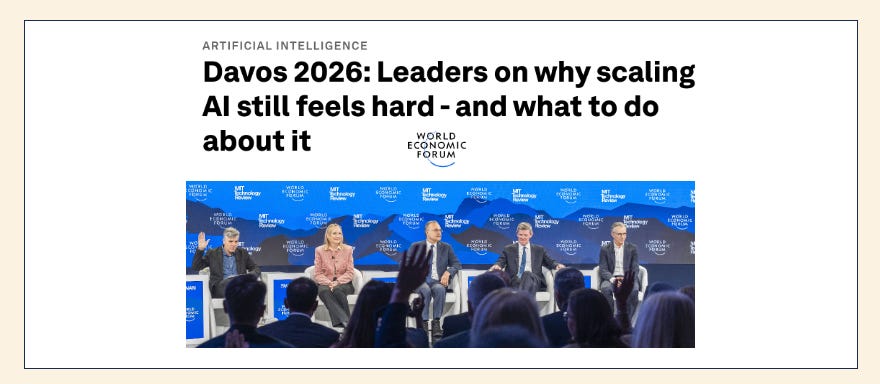
Last week at Davos, CEOs centered on a fundamental question: why isn’t AI working for us?
From where we sit at Andus Labs, the answer has little to do with AI itself. The patterns emerging from our work point to something else.
In 2026, companies are splitting into two camps: those realizing remarkable impact from AI, and those struggling to see any value at all. The data from Davos tells the story. Those seeing real impact remain rare.
When it works, it’s unmistakable. Strategists and research teams pressure-test dozens, even hundreds, of scenarios in a single session. Non-technical product leaders build functional prototypes before any engineer sees them. Talent leaders stand up working labs in the time it takes a consultant to write a deck.
In this mode, the unimaginable becomes routine.
We feel this firsthand. Our team discovers previously impossible applications every day. The only way to describe it is a fever-dream state: the overwhelming sense of possibility compounding on possibility. And it keeps accelerating.
What I keep seeing in the field: the gap between what AI can do and what most organizations do with it is widening rapidly, not narrowing.
AI investment isn’t the constraint. The lack of human investment and ingenuity to keep pace with it is the bottleneck.
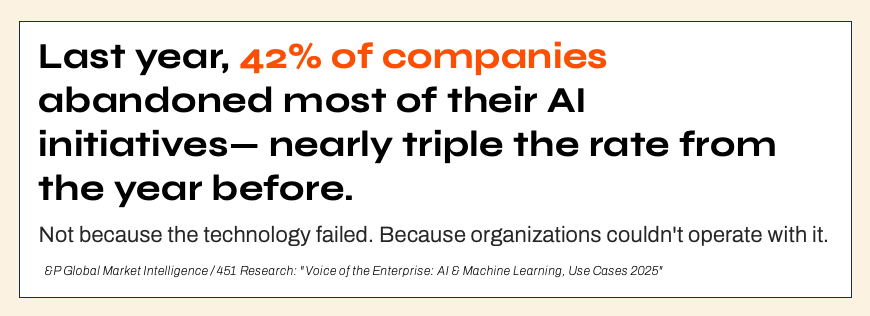
That gap is a crisis for every organization that bought the promise: buying ruinously expensive shelfware. In aggregate, billions invested in AI capabilities go unused because people aren’t invested in working with them.
Capabilities and Systems
This distinction matters.
AI capability is what the technology can do. It’s mindblowing. And there’s no ceiling in sight.
Human-centered investment will determine whether you realize the value of AI’s expansive power. Investments in spaces, workflows, permissions, habits, and coaching to move from “I saw another demo” to “this is how we work now.”
Organizations are sitting on vastly underutilized AI potential. Few have team-centered systems. They wonder why there’s a vast expectation gap.
Consider a tale of two companies.
Company A focused on enterprise licenses. Created three-year roadmaps. Ran a bunch of training. Built a center of excellence. Eighteen months later: single-digit adoption. The pilots that succeeded didn’t scale. The people who were supposed to change... didn’t. The executive team is now asked about ROI. No one has an answer.
Company A is sitting on shelfware. They’re falling behind. The gap widens every quarter.
Company B started smaller and more specific. Instead of focusing on long-term strategy decks and generic AI training, they invested in changing how work gets done with people doing the work. They didn’t announce transformation. They demonstrated it, one step at a time. Collective learning on how AI helps and fails accumulated. The team emphasized impact over adoption. Impact came from the bottom up versus the top down.
Twelve months later: AI is embedded in workflows—better, faster, more impactful workflows—not an “AI initiative.” Teams are excited and engaged. Cases accumulate.
What lies in between
The difference between the two scenarios isn’t magic.
It’s organization planning before tech planning. Executive sponsorship that doesn’t waver. Budgets tied to outcomes. Relentless testing and learning. Communication that never stops.
Company B begins building a Human OS. It aggregates the working practices and systems that accelerate how people best use and grow with AI. Not training. Not governance. Not tools. The underlying architecture for how work gets done better.
If these patterns sound familiar, ask yourself some questions:
What percentage of employees use AI daily?
What are teams building and learning?
What remarkable insights and cases have you captured?
Which workflows have changed?
Where’s the measurable ROI?
What are teams growing into—and to what end?
If the answers are unclear, you’ll know you don’t have a technology problem. You have an investment-in-your-teams problem.
And sitting on the shelf, AI isn’t just idle. It’s an anchor and competitive burden dragging you further behind faster-moving competitors.
Patterns are unfolding that address the Davos question. Leaders have a choice.
Invest in your people if you expect any value from investments in machines.
I recast this newsletter from “Perspective Agents” to “The Human OS of AI.” I’ve learned the real problem isn’t how we think about AI — it’s how we put it to use to improve ourselves and our businesses. The technology works. How to actually work with it is still being figured out.
Chris Perry is the founder and CEO of Andus Labs. The company builds human-centered systems and programs for organizations navigating AI transformation.
You can reach him at cperry@anduslabs.com
For more on the Human OS and how we put it to work: https://humanreadiness.com.
This nails it. The shelfware pattern I've seen at companies usualy comes down to expecting the tech to self-implement. People get excited about demos then realize the work to integrate AI into actual workflows is harder than anticipated. The Company B approach of building from bottom up with real use cases reminds me of how sucessful dev tool adoption works, start small and concrete, let results speak.
Chris, spot on. "That gap is a crisis for every organization that bought the promise: buying ruinously expensive shelfware. In aggregate, billions invested in AI capabilities go unused because people aren’t invested in working with them.” the human element is as important as the tools you choose to implement. I've been in SW sales for many years and the human factor has not changed in 20 years.