
Installed, Not Adopted
Enterprises deploy AI faster than people can absorb it. Field notes on why most get nothing back, and what separates the few who do.
In spring 2025, incoming students at San Jose State University received a video from their new president: “Congratulations on your admission.” But it wasn’t the president. It was her AI avatar, built to welcome a class she didn’t greet herself.
It’s one piece of AI Everywhere, SJSU’s push to put it into every corner of campus. In early 2025, the California State University system signed a $16.9 million deal with OpenAI for half a million ChatGPT licenses. SJSU called itself the nation’s first and largest AI-powered university. The licenses shipped, and the press followed. Call it performative AI.
It didn’t land the way it was sold. The New York Times Magazine published an account of what happened a year later, based on extensive reporting by Linda Kinstler. The headline reads, “A University System Went All In on A.I. Now It’s Tearing Itself Apart.”
According to Kinstler:
SJSU’s push coincided with a $2.3 billion deficit. In the same period, the system laid off tenured faculty, closed departments, and raised tuition by 6 percent. The tools switched on as students sat down for finals. “We didn’t know it was coming,” one lecturer said. A petition to cancel the contract drew 4,000 names. One professor called the rollout a smash-and-grab. Another called it a doom loop. “Faculty are feeling anxious,” a sociologist said. “Students don’t know how to behave. What are we doing here?”
Performative wins that fall short rest on flawed logic: licenses bought, dollars spent, press earned. Each win arrives before anyone asks whether the people inside know what the AI is for.
System administrators bought the capability. Their teams never built the capacity to use it. That gap is the difference between installed and adopted, and it’s where the money goes to die. Similar stories are playing out across the public and private sectors.
Vendors and consultants sell extraordinary productivity gains while omitting the fine print. Gains depend on people changing how they work. People are the part no purchase order can install.
The last time a promise like this ran through the enterprise, it had a name. In the 1990s, consulting firms sold it as Business Process Reengineering. Wipe the company clean, rebuild it around new technology, and book the savings. Michael Hammer and James Champy, the consultants who coined the term, wrote the epitaph themselves: as many as “50 to 70 percent” of reengineering efforts, by their own 1993 estimate, “do not achieve the dramatic results they intended.”
Peter Drucker named the trap a generation earlier. “There is surely nothing quite so useless,” he wrote in 1963, “as doing with great efficiency what should not be done at all.” An organization, Drucker argued, isn’t a machine you reengineer. It’s a human institution, and its first job is to enable people to work together well.
Whether a company is getting more capable is a question of effectiveness. No AI dashboard has a gauge for it.
A notebook becomes a perspective agent
I’d been watching Drucker’s truth get ignored, one room at a time, for two years.
In January 2023, I attended a CNBC dinner at the World Economic Forum. The week opened in a panic about a recession. By midweek, ChatGPT took over the agenda, and talk turned to what it would mean for companies. At dinner, an executive next to me started to answer, then reached for his wine. He knew something under him had moved and didn’t have the words to describe it.
When the people running the world’s largest companies can’t say what AI will do to them, naming it becomes the work. I’d had a head start, but no right to feel above it.
I published a book in 2023 on the human impact of AI while building AI capability inside a global holding company. I was reading the green dashboard, and for a while, I believed it. My notebook began as the gap between what the technology’s potential told me and what I found when I went down one floor.
A pattern came into view. People could describe the shock of using ChatGPT for the first time. They knew it would change their work but had no idea how. The change had arrived. Words and best practice had not.
The pages in my notebook filled with new tools (ChatPDF, NotebookLM, Midjourney) and observations from meetings: “co-pilot delay,” “it’s not a calculator or an intern,” “tool overwhelm.”
One verdict kept repeating, the one no AI roadmap carried. What makes or breaks an AI program isn’t the model. It’s what people do with it, and what they use it for.
To see that, you watch people the way a naturalist watches an animal in the wild. Not through soundbites, not by chasing model upgrades. You watch what it does to people who have to use it. That’s the ground truth.
Now, observed patterns come faster than a notebook can hold. So at Andus Labs, we built the instrument AI dashboards don’t have. We call it the Grove. It’s an intelligence system that reads our field notes and surfaces barriers to adoption and impact. Our researchers check and qualify each one. They generally fall into three groups: leadership, the tool’s fit, and people’s resistance.
The most expensive question
A National Bureau of Economic Research study led by Stanford’s Nicholas Bloom surveyed roughly 6,000 executives. It found that nearly 90 percent of firms reported no effect of AI on productivity or employment over the past three years. Goldman Sachs found gains to be real but concentrated, two use cases compounding while others stagnate. BCG, riding the AI consulting wave, reports that 94 percent of companies will keep spending even if it returns nothing this year. Failings are thoroughly measured. The cause is not.
Our Ground Truth Index, Release 01, ranks the 25 patterns doing the most damage right now. Each one is a human factor that the dashboard can’t read. The biggest this quarter is the Trust Deficit.
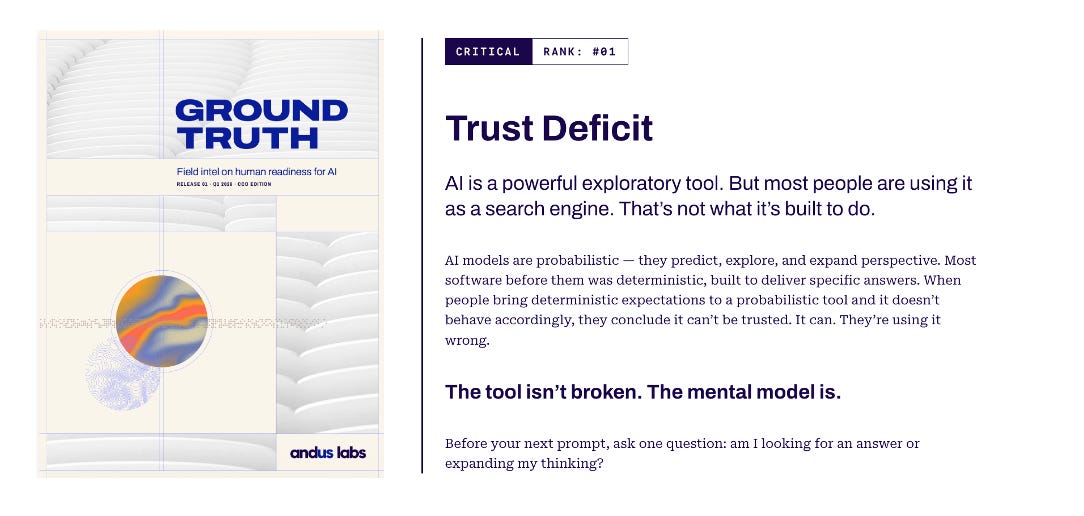
People don’t trust what AI hands them, partly because they’re conditioned to use it for faster search. The made-up answers don’t go away with the next prompt. They’re built into how generative AI works. It predicts its way to an answer. Software we rely on is built to return the one right answer. So most people use AI at its shallowest, asking it to fetch when they could be thinking with it. It lets them down, and the letdown hardens into distrust.
Close behind is Devaluation Anxiety, the quiet engine under resistance inside companies and the loud one out in the street. At SJSU, the fear wears a cap and gown. Students can see they’re training for jobs that will be rewritten by the time they graduate, on a campus that cut its professors to pay for software. The fear is rational. It’s also a readiness problem, which means it has an answer.
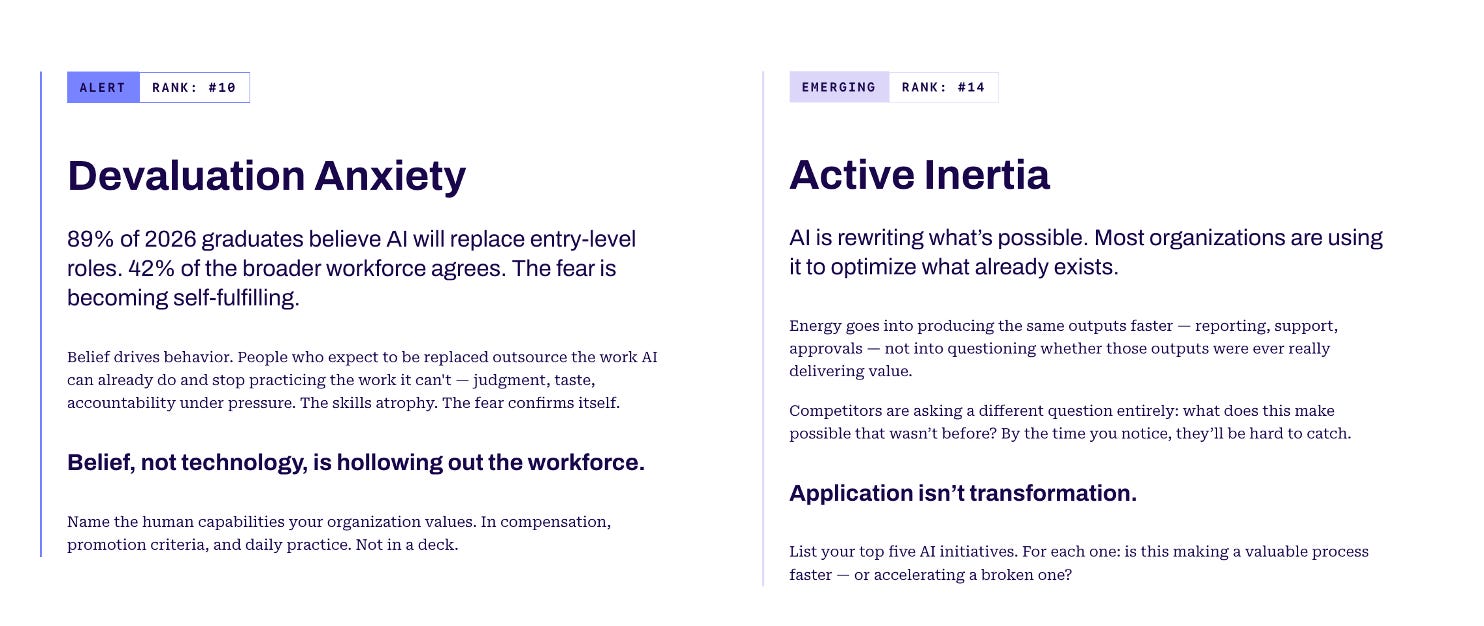
Active Inertia reflects the use of AI to do the same work faster, and calling it progress. Stanford Social Media Lab and BetterUp Labs gave a piece of it a name last year: workslop, work that looks finished but quietly passes the real job to whoever cleans it up. It’s Drucker’s useless efficiency, on schedule. The motion looks like change. The work underneath is the same or worse.
Active Inertia has an opposite. You can see it in Kinstler’s Times story. Roxanna Medina, thirty-eight, was back in school for a classical social theory course after years at home raising her son, the daughter of immigrant parents she describes as living “the hustle-bustle kind of life.”
For one assignment, she sat with MarxGPT, a chatbot her professor built, and asked whether Marx still explained the acceleration of technology, whether his frameworks still held. The bot told her that the workers of the world were still struggling and that “capitalism has found a new way of hiding things.”
She experienced firsthand what AI-driven productivity-seeking hides: the value of work like hers. In dollars, the years she spent raising her son were worth nothing. In meaning, everything. A machine pretending to be Karl Marx taught a worker the worth of her work at home and the office.
The welcome avatar was a different tell. A president built a machine to greet a class she would never meet, and set it where her humanity belonged. The whole failure is in that substitution.
A machine can deliver a welcome. It can’t ask the question that matters. Are the people ready to use it? SJSU didn’t anticipate that before it announced and deployed AI. It’s an expensive question overlooked in all the AI hype, and the easiest to skip.
For two years, I had no language for patterns like this. Now we have hundreds in our Grove, compounding daily. The inventory won’t tell you whether your model works. It tells you whether your people are ready to make it work. And if not, why.
Technology is what technology does. Used one way, AI is a perspective agent. Used another, a replacement agent. One machine pretended to be Karl Marx and taught a worker the worth of her work. The other pretended to be the president. It welcomed the class, spoke to parents in languages she never learned, never tired, and never asked a single student a question.
The models work. Whether your leaders and your teams are ready to work with it productively is the question that decides the return, and almost no one can answer it. Now you can.
The Ground Truth Index, Release 01, is public and accessible here.