
False Forms
Work took on new substance and kept its old shape. Meetings are the proof.
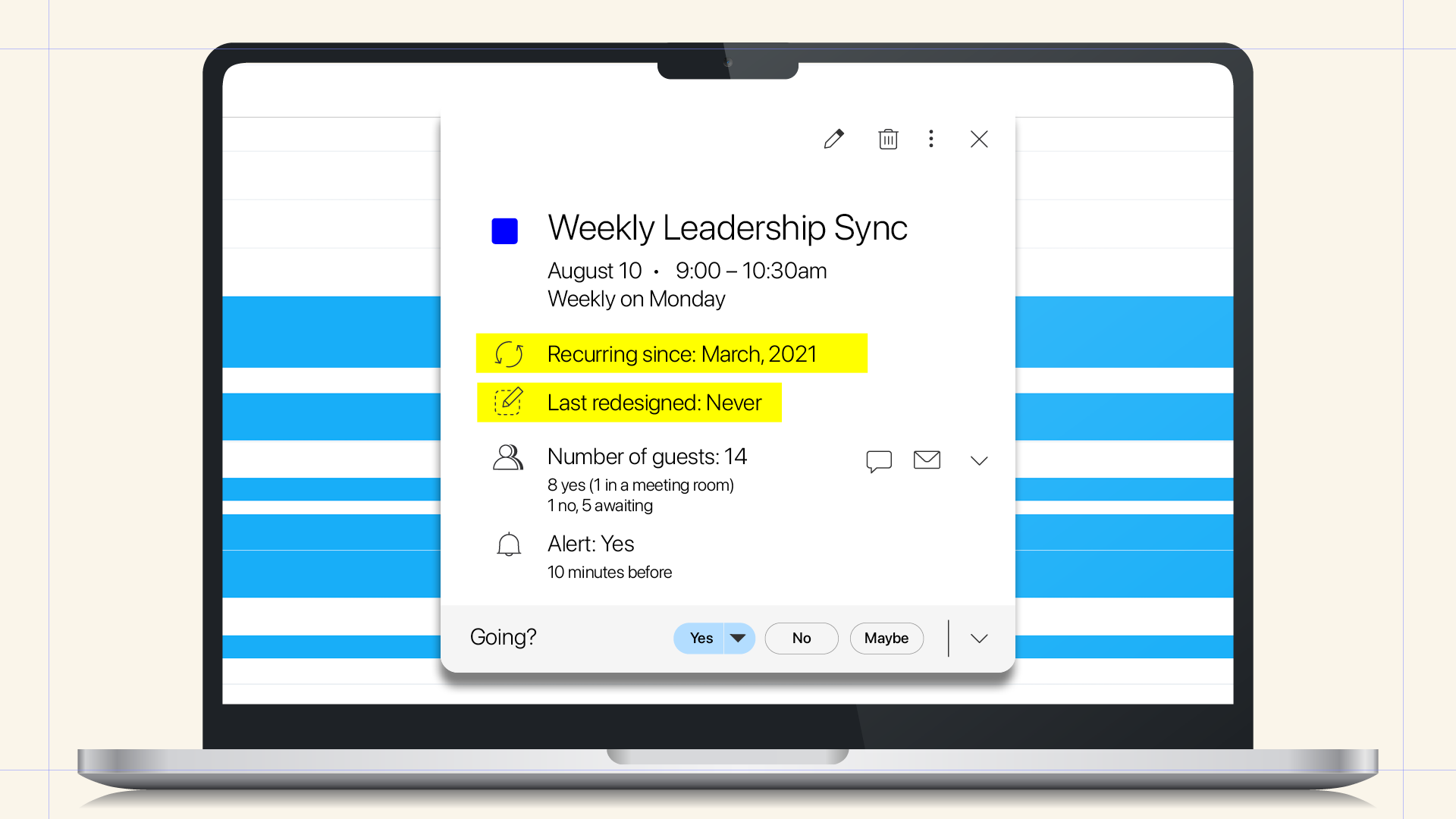
The invitation renews itself every Monday at nine. It’s done that for five years, a standing leadership meeting that outlasted the person who originated it.
Fourteen people accept. Every one of them holds a license for an AI model that updated since the last time they met.
The pre-read is the same pre-read, built in half an hour instead of six. The decks are enhanced thanks to Copilot. When the ninety minutes end, some of the actions have no owner.
What came into the room got faster. The room didn’t move.
The Rock That Keeps Its Form
I went looking for a word for this. The closest one is in geology.
A crystal sits embedded in stone. Water works through it and carries it away molecule by molecule, and a second mineral settles into each space as it opens.
The outline never breaks. What a geologist pulls out of the ground has the outward form of the first crystal and the chemistry of the second.
The name for it is a pseudomorph. A false form. Every visible property says one thing. The substance says another.
Lewis Mumford applied the concept to civilizations in Technics and Civilization. New forces creep into the structure of an existing order and settle into the contour of whatever is standing. The energy is genuinely new. The vessel is old.
In companies, meetings are a pseudomorph with recurring behavior: who presents, who listens, how long the meeting runs, who signs off before work moves.
The substance is what people produce inside that form.
AI changes the substance almost everywhere and the meeting almost nowhere.
I live inside this rock. We built Andus Labs to be native to AI work, with no inherited meeting structure and no approval chains designed for documents that take days or weeks to produce.
We catch ourselves reaching for the old forms.
There’s a standing call that exists because standing calls exist. There’s a review step that asks the same questions as before, when work built with agents needs new ones. We update how we work together most weeks.
Some weeks the old shape wins.
Nobody inside a pseudomorph knows they’re in one. It just feels like work.
We Manage What We Count
I sat with a company reporting 80% AI adoption against something closer to 5% functional change. Only the adoption number made the board deck, and it wasn’t because the team was hiding the other. The omission was honest.
The dashboard has no field for redesign, so no one is accountable for its absence.
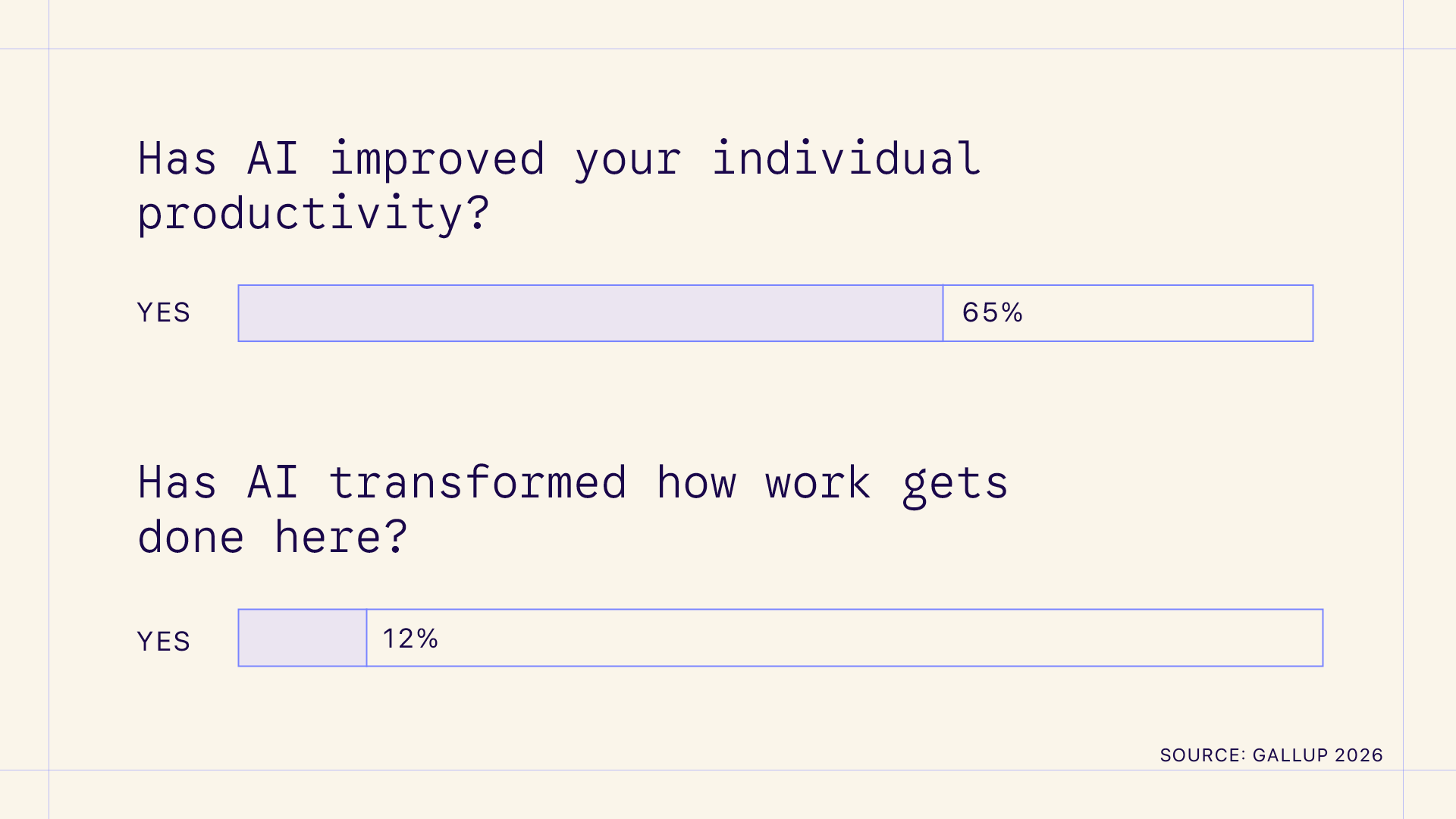
Gallup put a figure on the gap. Inside organizations that have adopted AI, 65% of US employees say it has improved their own productivity. Only 12% strongly agree it has transformed how work gets done. The first measures what a person can do at a desk. The second measures whether a unit of work was rebuilt.
A meeting is a standard unit of work. The calendar is where productivity gap is easiest to see. According to Microsoft, the average meeting length moved from 51 minutes to 47 between 2023 and 2025. Meetings after 8 p.m. increased 16% year over year. The ritual held its shape and moved into the night.
Inertia carries a price. Researchers at the London School of Economics rated 35% of business meetings unproductive and put the annual US cost at $259 billion.
What moves numbers like these is behavior. This productivity fix requires no platform and no procurement cycle.
It needs the person running the meeting to run it differently.
Manager Support to Management Change
The obvious move is to hand the challenge to managers, and new data appears to agree.
According to Gallup's State of the Global Workplace 2026, “manager support” is one of the two strongest drivers of frequent AI use, alongside workflow integration.
Access ranks lower. Training ranks lower. Where employees say their manager actively supports the team’s use of AI, they are 8.7 times more likely to say the work has been transformed. Fewer than a third say that support exists.
An 8.7x multiplier on a variable that costs nothing to procure should be the loudest number in the industry.
The problem is manager support sounds like a mood. It suggests enthusiasm, a leader who happens to be personally engaged in AI. Read that way, it becomes a personality trait, and personality traits don’t drive the change AI promises.
Blaming managers for unproductive activity is where the argument veers off track.
No one handed them a meeting handbook or a definition of good AI use.
The decision to deploy it was made inside a technology function, on a technology budget, against technology metrics. It arrived as a license and a training program. When outcomes are assessed, shortfalls read like management flaws.
So with meetings, the form persists, and the reason underneath it is simple. It was standing when the team arrived, and it will be standing after they’ve gone.
Give It an Author
See if this sounds familiar now.
A colleague presents a vibe-coded demo spun up overnight. As you review it, you notice it says little about what the meeting is for. It has every appearance of finish and no way in.
The novelty of what AI can do obscures the question of what should be done, and done well.
Underdeveloped work used to carry information. It showed the room where the thinking was thin and who needed help. The faux-finish on AI-produced work pushes that signal out.
That’s production. Authorship is owning how the meeting works as much as what gets decided in it, with the standing to change the length, the agenda, the format, the pre-read, and who presents.
Frontier AI companies evangelize workflow change. The most visible workflow in any company is the meeting, and every product routes around it.
Now interventions are small enough to be actionable and material at the same time.
In 2022, Shopify built a calculator that prices a meeting before anyone accepts it. It’s something that today can ship in an afternoon.
Six months earlier, leadership ran a bot that deleted 12,000 recurring meetings overnight and changed the default answer to an invitation from yes to no, regardless of who sent it. They claim 322,000 hours came off the calendar.
Creating the tools was the easy part. The bots changed behavior because someone authored it and made declining meetings safe.
Today, every model in the building will update again before the quarter ends. The forms they run through will change when a person with standing decides they should.
One of those clocks runs on its own. The other waits to be wound.
Never thought a geology metaphor would hit this close to home.