
Boxes and Nodes
When information is mediated by machines, placement stops working. What the people who study media for a living see coming.
In 2016, I was leading innovation at Weber Shandwick, the global communications firm. Decoding the information environment was the job.
That June, Britain voted to leave the European Union. That November, the United States elected Donald Trump. The polls and the press missed big on both. These sources misunderstood how power worked by different rules.
A public that once read from the same page was splintering into social feeds and group texts. No one had built the capacity to read the new environment. Two years later, I built an AI-first media lab to see the wave as it crashed in. We didn’t decode it alone.
A circle that studies media like weather
For years, we worked with an ad-hoc group that studied media the way meteorologists study the weather. The one I know best is Andrew McLuhan. Marshall’s grandson and Eric’s son, he founded the McLuhan Institute. A few years ago, he took a dozen of us, line by line, through Understanding Media. He later wrote the foreword to my book.
His grandfather’s most-quoted line is “the medium is the message.” He never wrote another one that people hang on him, “we shape our tools, and thereafter our tools shape us.” Andrew’s quick to remind me of John Culkin, who did say it in 1967, echoing something Churchill had said about buildings in 1943.
There’s a lesson in misattribution. We repeat warnings without remembering who said them as the tools continue to shape us.
What they shape us into is John Borthwick’s question. Andus Labs is housed at Betaworks, the New York start-up studio he built over two decades. He named the problem early and called it data serfdom. It’s what happens when we unwittingly hand over our time, data, and attention to platforms built to harvest them.
John is the type of seer of deeper implications as our brains change and adapt to the data layer that surrounds us. Now, deep in the world of building agents, every day at Betaworks is its own education.
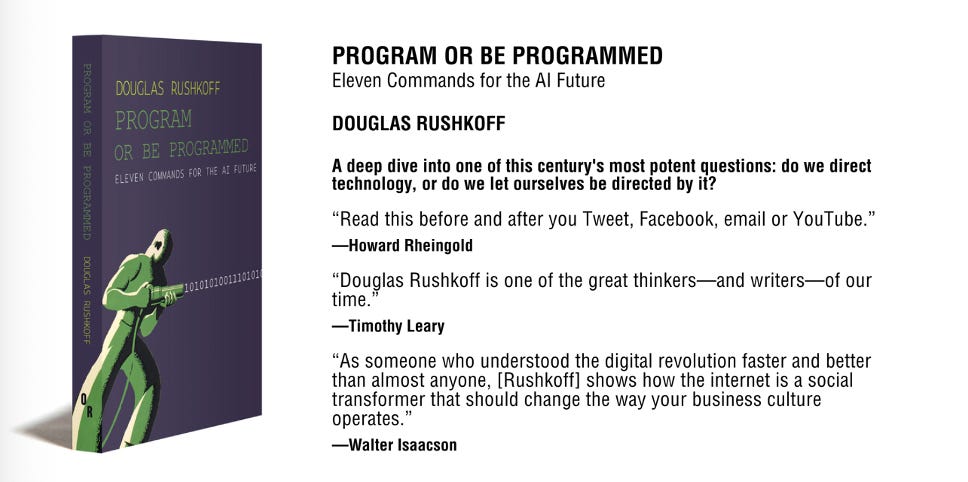
Others in the circle watch different facets of the same shift. Douglas Rushkoff, a founding member of our team, warned 16 years ago to “program or be programmed.” Claire Wardle pioneered the study of information disorder, teaching that media rot extends beyond the lie. The real rot stems from the environment that rewards it.
Tracey Follows writes about identity as something that technology changes without our consent. Her latest provocation, the ‘Database Brand,’ suggests that, in the age of AI, a brand stops being something you design and becomes data that the machine reads and reassembles without your permission.
Instrumenting an ecology
The list could go on. Tony Haile especially stands out for making the digital ecology visible to publishers.
Tony is the mind behind Chartbeat, a real-time dashboard that showed a newsroom how many people clicked on a story and how long they stayed. It arrived as web-native outlets like Gawker and the Huffington Post were taking off.
Chartbeat laid bare how incentives shaped what people clicked and what newsrooms chased. The data carried troubling signs. He wrote, “We confuse what people have clicked on for what they’ve read. We mistake sharing for reading.” More than half of the page visitors tracked gave fewer than fifteen seconds of attention. The click was never the value. It was the thing we could count.
Last year, Tony put out a different provocation. He warned, “The web made print a vestigial business line for news publishers. AI is poised to do the same thing to the web.”
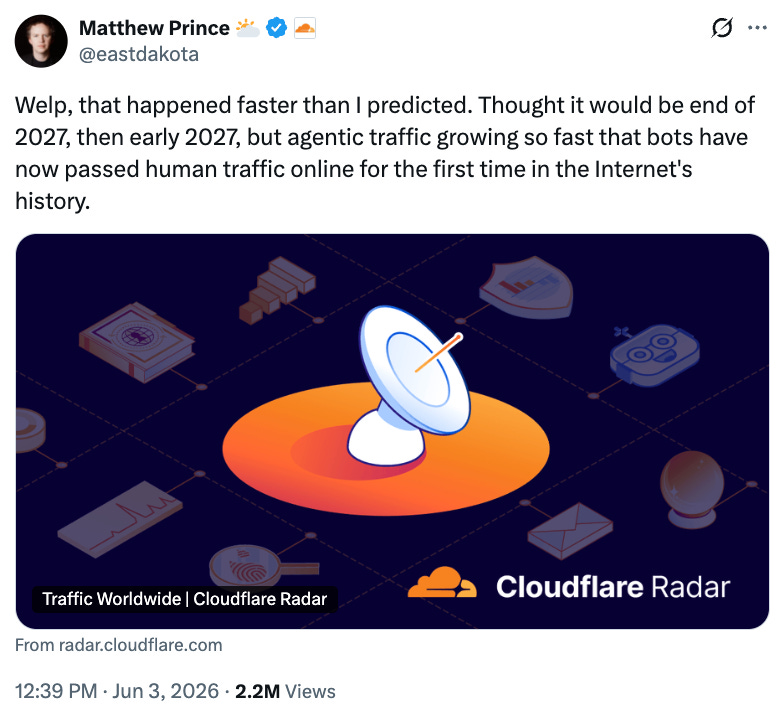
This month, Cloudflare reported that, for the first time, machines sent more requests to the web than people did. The open web ceased to be a human place.
If your job is to understand media currents, where do you begin?
The best place is with the people who have spent their lives learning to see it.
Andrew would make the medium visible first. A medium is environmental, he says, and we don’t notice it until someone holds it up to the light. Once it’s visible, Rushkoff would move you from the figure to the ground. The figure is the thing we look at. The ground is what it changes around us. With a bot-powered internet, the figure is the network. The ground is the human effect, what we come to believe and how we behave when machines direct us.
Neural media obsolesces broadcast
Seeing the medium is one thing. Recognizing that it’s become the dominant medium is another. That’s where K Allado-McDowell comes in.
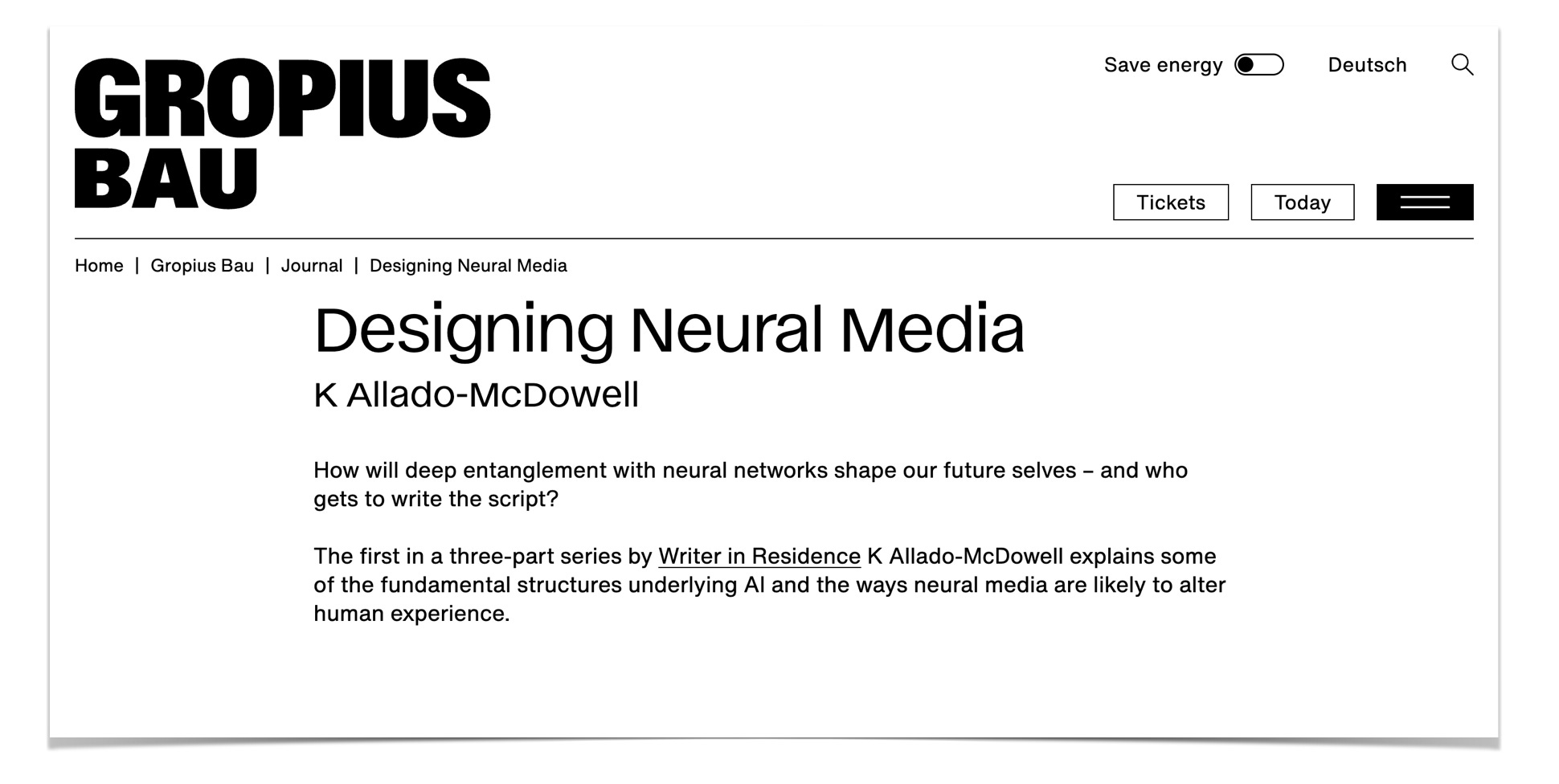
K started the Artists + Machine Intelligence program at Google and wrote Pharmako-AI, the first book co-written with GPT-3. Last week, K shared their work at an Andus Labs Salon, calling out patterns reshaping media. What we are living through, K said, is the arrival of ‘neural media.’
The transition speaks to media economics now out of whack. Before the arrival of a neural medium, the web ran on a simple trade. Search engines crawled your pages, took your words, and in return, sent you readers.
Those readers saw an ad, and the ad paid for the words. For roughly every dozen pages it crawled, it sent one visitor back.
Neural media doesn’t keep the deal. Crawlers take and don’t return. Last year, Anthropic’s crawler fetched tens of thousands of pages for each reader it sent back. The web’s metabolism, words for readers and readers for rent, is draining from one end.
Boxes and nodes
Andrew has a word for what is happening. Obsolescence. An obsolete medium doesn’t vanish. It moves backstage, from the lead role to the scenery, while a newer medium takes over.
Digital felt like that newer medium. It wasn’t. It was the broadcast box, moved online. A film made for the screen. A story set in the right section of a website. A social ad unit cut to whatever format the page will take. The surface changed, and the spending followed. Global digital ad spend in 2026 is roughly $836 billion, within a total ad market of about $1.2 trillion.
In the network, the box becomes a node. A node is a piece of information that a machine can read without guessing. It lives in the connections that carry a story, not the page that once held it. A node is how you surface and interact in the network.
Building for nodes rather than boxes is a new discipline, and it has a name: machine-readable communication. The work starts before a word of copy, in how you structure your information so a machine can read it, hold it, and carry it without distorting it.
In a network of nodes, a piece of communication is one citation among the thousands a model weighs. If your footprint is invisible to a crawler or contradicts it, the placement doesn’t reveal much about you to the machine.
68% of Google searches now end with no click. Roughly 75% of new web pages now contain AI-generated text. In this environment, generating clear and consistent nodes is now a necessity. To start, it’s how you prevent a machine from summarizing you into something you never said.
The SEO industry, built around the search box, is worth about $75 billion a year. Global search advertising runs past $300 billion. Almost all of it is still spent to win a click that fewer and fewer humans will make. It represents a quarter-trillion-dollar-plus market about to be rebuilt around machine-readable communication.
Reading the medium
I dove into media ecology in 2016, when expertise in networks was scarce. My friends taught me that the instruments aren’t the problem to begin with. The mental model behind them is the gate.
Culkin’s line, the one we keep hanging on Marshall McLuhan, was right even if the attribution is not. We shape our tools, and thereafter our tools shape us.
We’ve built a medium that reads and writes the world faster than we can watch it, and we still call it a tool.
The focus is no longer how to fill a page. It is whether our communication is clear enough and connected enough, node by node, to be read by a machine and carried to a person who may never hear from us directly.
That’s what McLuhan meant by the medium being the message. The people I admire, the ones who study media the way others study weather, are the antennae of a new era.
They taught me to read the medium. Now it reads us back.
“A brand stops being something you design and becomes data that the machine reads and reassembles without your permission”
Replace “brand” with “identity” and this is the new reality of growing up online. Half-formed opinions, performances, moments with friends, all logged. I’ve watched a few of those moments surface and bite people years later. Future generations are being read and reassembled before they’ve had a chance to figure out who they are.
Every generation has had to construct an identity separate from how they’re perceived, that’s ancient. What’s new is that the archive doesn’t fade. It holds moments without context, retrievable at any time by machines that have no idea what the moment meant. That’s where it stops feeling like a technology problem and starts feeling like a spiritual one. The cruelty isn’t the permanence.. but the timing. Adolescence is the exact window when you’re supposed to be allowed to be experimental and unfinished.
If the machine already has a version of you, how do we teach the next generation they can author and edit themselves instead of just react to what gets surfaced?
Incredible piece Chris!
Great piece! Side note: I find Manuel Castells’ space of flows as is a useful mental model for the shift from SEO to GEO/AEO era.